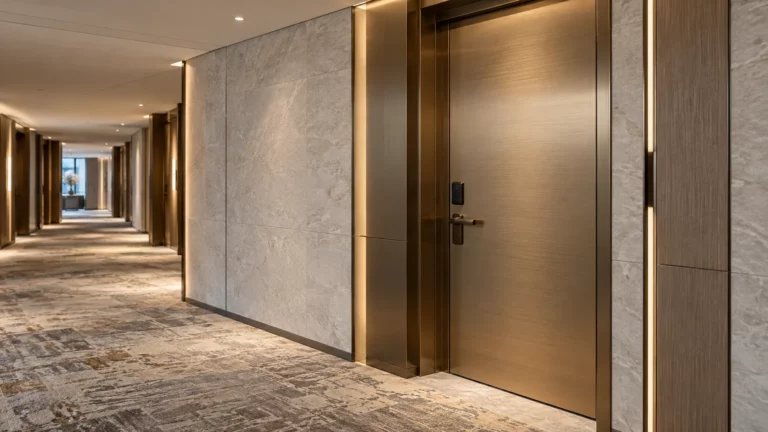


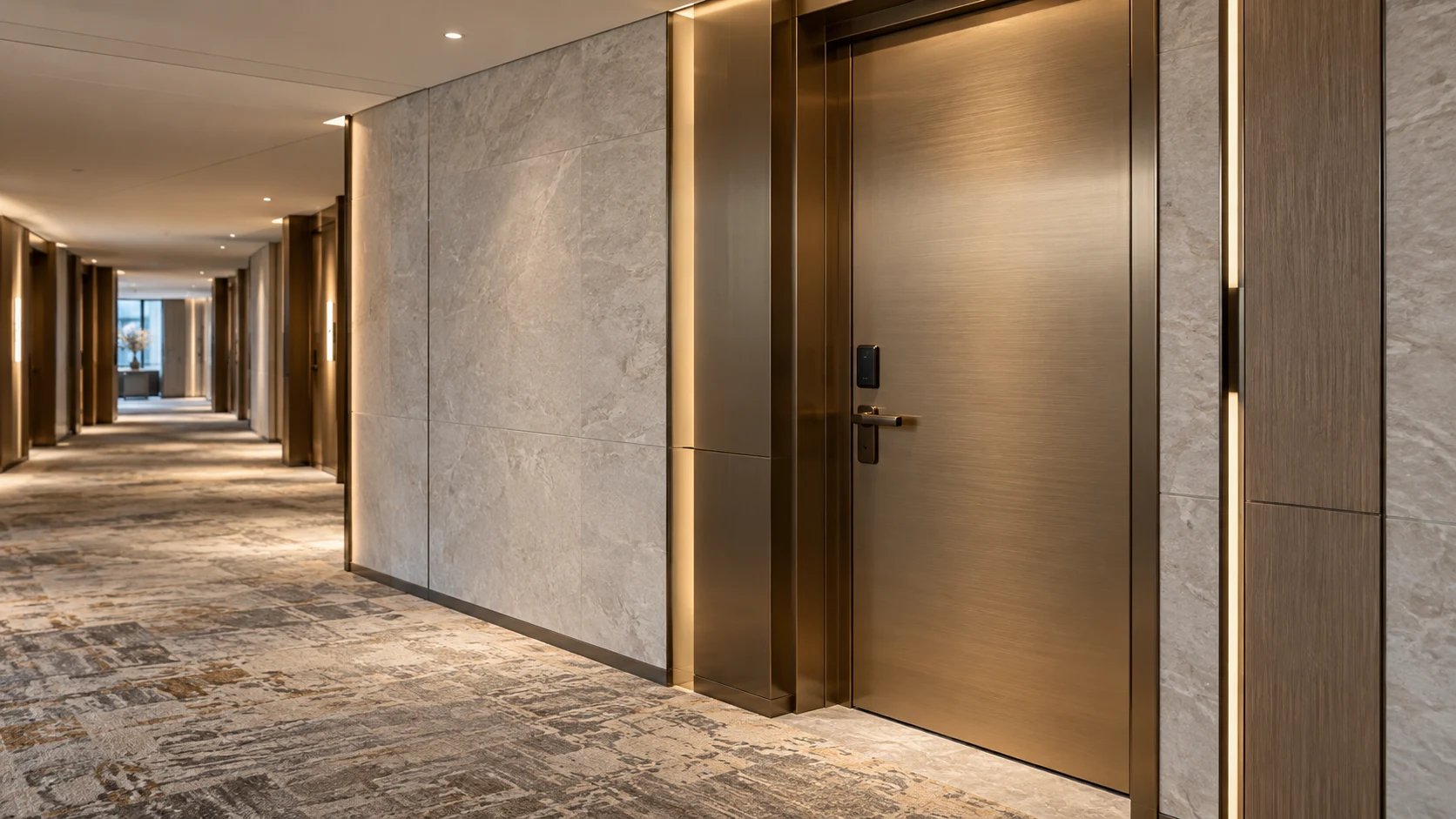
Hotel door packages fail when the decorative leaf is selected first, hardware is added later, and fire performance is checked at the end. Define the opening as one coordinated assembly, with visual language, operating cycle, clearances, and rating agreed before fabrication.
The goal is not simply a distinctive finish, but a door that fits the wall, supports hardware, works for guests and staff, and can be documented against the applicable approval path. Inoxfurt Metal’s hospitality work includes custom partitions, metal wall panel systems, elevator door frames, mirror frames, and other decorative products, so the door should coordinate with the surrounding metal package.
Start With the Hotel’s Door Schedule and User Journeys
The first useful document is a door schedule that connects each opening to its user, location, and consequence of failure. A guestroom entry, a back-of-house service door, a stair door, a ballroom partition, and a plant-room opening may all be metal, but they do not share the same priorities.
For every opening, record:
- Location, wall type, opening size, handing, and swing direction.
- Guest, staff, service, or emergency egress use.
- Traffic frequency, cleaning exposure, impact risk, and acoustic expectations.
- Required access-control device, closer, latch, pull, panic or exit hardware, kick plate, and signage.
- The fire and smoke-control requirement assigned by the code professional or authority having jurisdiction.
- Finish, reveal, joint, skirting, and adjacent wall or ceiling interfaces.
This schedule gives the fabricator a controlled basis for shop drawings and questions.
Separate the Visual Concept From the Performance Assembly
Custom metal doors for hotels often sit in a highly designed lobby, corridor, spa, restaurant, or suite. The visible face may need a particular tone, texture, perforation, inlay, or alignment with wall panels. Those choices are important, but they should be layered onto a performance assembly that has already been defined.
Separate visual elements from functional ones. A decorative skin, trim frame, shadow gap, or applied profile must not interfere with the door edge, latch, closer, hinges, or clearances. A heavy finish build-up can change leaf balance, so review the construction as a section, not a front elevation alone.
An early material and finish board should show the door, frame, adjacent partition, hardware finish, seal color, and representative lighting. Inoxfurt Metal’s custom metal decorative doors can help align the hotel door design with the surrounding architectural metalwork. Keep samples tied to a written finish description; a photograph alone cannot control sheen, grain direction, patina variation, or color under hotel lighting.
Coordinate Hardware Before Fabrication
Hardware is where many attractive door concepts become impractical. The team should freeze the hardware concept before the metal shop releases production drawings. This does not mean every brand or model must be selected immediately, but the interface requirements must be known.
Confirm the following with the hardware consultant and door fabricator:
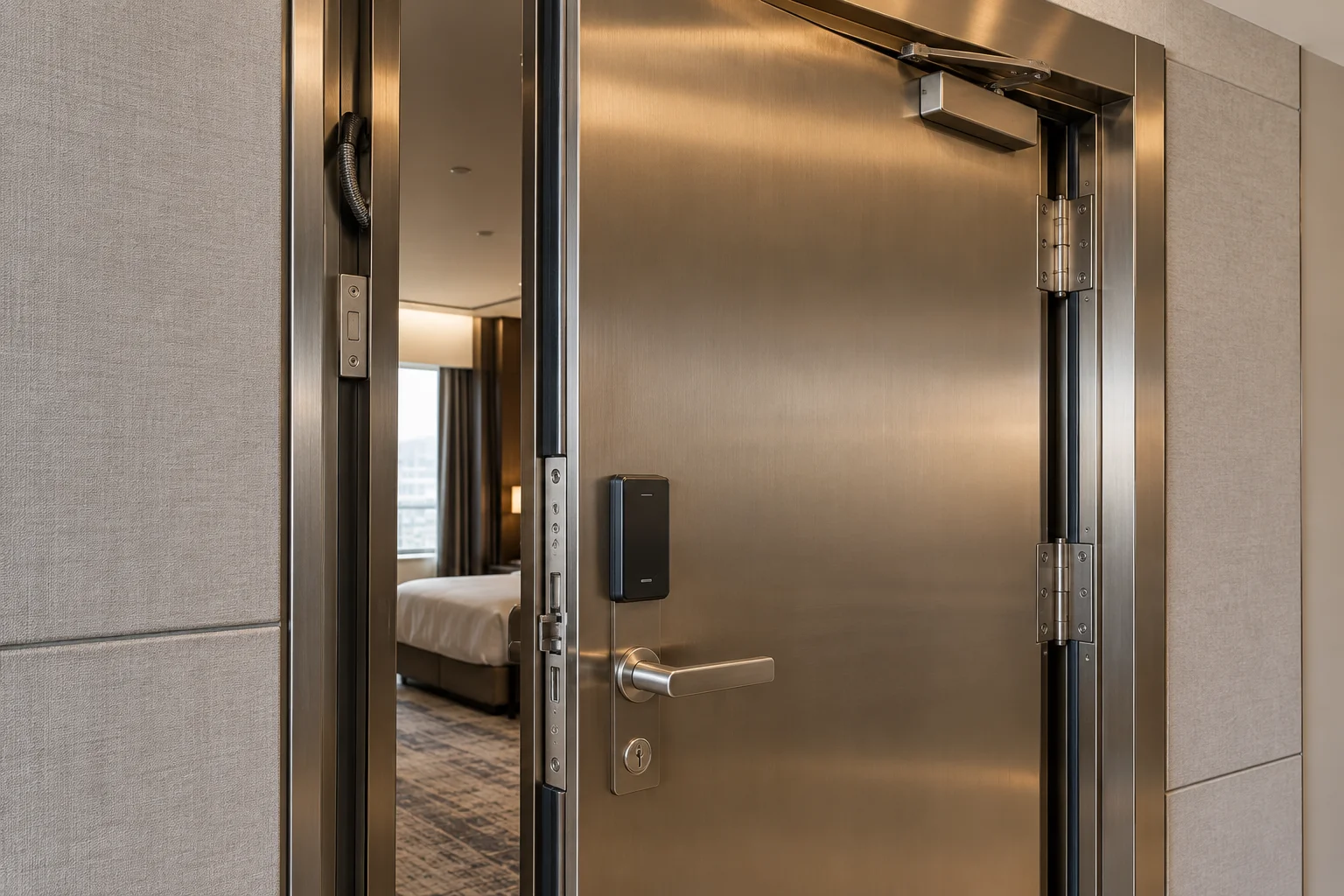
- The lock case, strike, hinges, pivots, closer, and any access-control components fit the proposed stile, rail, and frame depth.
- Cable paths, power transfers, readers, request-to-exit devices, and monitoring contacts have a defined route and service strategy.
- Pulls, lever handles, panic devices, and protection plates do not conflict with reveals, applied trims, or neighboring doors.
- The door can open to the required angle without the handle, closer, or wall finish colliding with another element, and maintenance staff can reach adjustable components without dismantling decorative panels.
Hotel door hardware also has a human-factors role: guestroom doors should be intuitive and quiet, while service and public-area doors may prioritize controlled access and impact resistance.
Treat Fire Rating as an Assembly Requirement
“Fire-rated metal door” is not a finish description and it is not automatically a property of every steel or aluminum door. A rating applies to a tested and approved door assembly, typically involving the leaf, frame, hinges, latch or lock, closer, seals, glazing where present, and installation conditions. The required duration and temperature or smoke-control criteria depend on the opening’s location and the governing code.
Obtain the fire-rating requirement from the code consultant or authority having jurisdiction, then ask the supplier to identify the approved assembly that meets it. Verify documentation, permitted hardware, frame and wall conditions, maximum dimensions, and limits on glazing, louvers, penetrations, or field modifications.
Do not assume that a decorative overlay, concealed closer, electromagnetic hold-open, access-control retrofit, or unusual threshold is acceptable simply because the base door has a rating. Any change that affects the leaf, frame, hardware, seals, or installation may require review against the listing or approval. The safest specification language is performance-based and conditional: the supplier must submit an assembly whose rating and components match the project requirement.
Resolve Door, Frame, and Wall Details Together
A hotel opening is a junction between several trades. The metal door frame may meet drywall, stone, timber veneer, a metal wall panel, or a glazed screen. If frame depth, reveal, or anchorage is not agreed early, the finished door may look misaligned even when the leaf is well made.
Use coordinated head, jamb, and threshold sections. Show wall build-up, fire stopping where applicable, seals, anchors, shadow gaps, skirting, floor transition, and finish tolerances. For wet or coastal areas, identify drainage, corrosion exposure, cleaning chemicals, and separation between dissimilar metals. For acoustic rooms, show the perimeter seal and under-door strategy.
Inoxfurt Metal’s engineering service and fabrication service pages describe the kind of design-to-production coordination a custom metal package requires. The useful procurement question is not whether a supplier can make a beautiful panel; it is whether the supplier can turn the coordinated section into controlled shop drawings, samples, and repeatable production details.
Build a Submittal and Inspection Sequence
Start submittals with the door schedule, performance criteria, finish intent, coordinated sections, hardware matrix, samples, and proposed fire-rating documentation. After comments are resolved, issue an approved-for-fabrication set with revision control. Before shipment, inspect dimensions, handing, finish, hardware preparation, and labels. At installation, check frame plumb, anchorage, clearances, seals, closer action, latch engagement, access control, and alignment with adjacent metalwork. Retain approved drawings, product data, labels, and commissioning records for facilities staff.
How to Evaluate a Custom Metal Door Supplier
Compare suppliers on coordination as well as fabrication. Ask for hospitality references, hardware and wall-interface drawing review, finish-control procedures, fire-assembly documentation when required, delivery identification, and a clear RFQ response format. Inoxfurt Metal presents hotel projects in the Middle East and Asia and groups its scope into customized work, materials, surfaces, and systems. That breadth may help when doors must coordinate with partitions, wall panels, and frames, but final suitability still depends on project drawings, selected materials, hardware, and approvals.
Қорытынды
Custom metal doors for hotels perform best when design, hardware, wall construction, and fire requirements are developed as one package. Begin with a location-based door schedule, define the visual intent separately from the performance assembly, freeze hardware interfaces before fabrication, and require approval evidence for any fire-rated opening. Coordinated sections, controlled samples, and a complete submittal record then carry the intent through installation and future maintenance.
For a project review, share the opening schedule, drawings, target finish, hardware concept, required rating, quantities, and delivery phases with Inoxfurt Metal’s technical team. This lets the supplier confirm scope and what must be verified before quotation.
Жиі қойылатын сұрақтар
Are all custom metal doors suitable for hotel fire doors?
No. A fire rating belongs to a tested or approved assembly and its installation conditions. The supplier must confirm the exact leaf, frame, hardware, seals, glazing, and rating documentation for the opening.
Should hotel door hardware be selected before the metal door is fabricated?
Yes. At minimum, the interface requirements and hardware envelope should be fixed before shop drawings are approved. Late changes can affect stile depth, reinforcements, cable paths, clearances, and finish details.
Can a decorative metal finish be added to a rated door?
Possibly, but only when the proposed construction is permitted by the applicable approval or listing. Added skins, trims, penetrations, and hardware changes should be reviewed rather than assumed acceptable.
What information should be included in an RFQ?
Include opening dimensions, wall type, handing, location, use, finish, hardware concept, required fire or smoke performance, quantities, drawings, and project delivery phases.
How can a hotel keep the door package maintainable?
Document the approved assembly, label each opening, preserve access to serviceable hardware, and record commissioning checks.