

In perforated metal architecture, there is an ability to create visually flexible materials that can perform in the building. With the ability to design the shape, size, spacing, open area, materials, and surface finishes of the holes, metal panels are not only capable of being aesthetically pleasing but also functional in their abilities.
Тот баспайтын болат and aluminum are commonly used metals in architectural perforated metal panels due to their ability to create exact patterns for facade, ceiling, partition, wall cladding, screen, and feature application. Below are some uses of perforations in architecture.
Playful Interplay of Light and Shadow
Metal perforation has the ability to turn natural and artificial lighting into a creative tool. The patterns created by the light that goes through perforated holes will vary depending on the panel shape, viewing angles, and the time of the day.
The size and spacing of the perforation holes affect this greatly. Tiny holes will produce shadowy patterns while big holes will produce bold patterns and transparency. Gradient hole sizes can lead to patterns that start out looking opaque and get progressively more transparent.
Adding backlighting to this opens up a whole new possibility. This is especially important in the hospitality, retail, lobby and feature wall industry where the panels look solid when there is daylight and layered in the evenings.
Custom Perforations Create Stronger Visual Identity
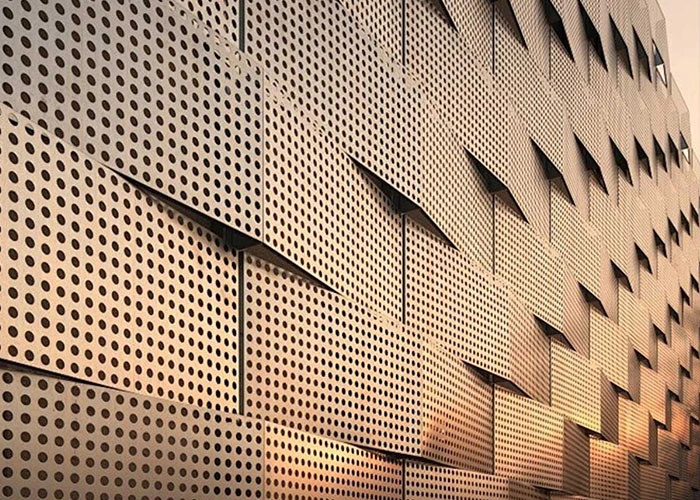
The visual quality of perforated metal panels in architecture is influenced by many more factors beyond just the material. Circular, square, slots, geometrical, and custom perforations all speak different architectural languages.
Perforations in straight lines create a tidy appearance, whereas the off-setting of these results in greater visual density and continuity. Custom laser cutting enables the inclusion of geometric variations, gradients, cultural imagery, or specific design images.
The application of finish on the surface of a metal will affect its appearance. There are various types of metal finishes, such as brushed, satin, mirror, textured, or colored; each reacts differently to lighting and environment. The combination of finish, pattern, size, and joining of panels makes perforated metal useful as an architectural surface.
Improved Solar Shading and Airflow
Perforated metal screens can create a good compromise between solar shading, daylight, visibility, and ventilation. The key design issue of the perforated screen design is its open area ratio, which is calculated based on the percentage of openings of the perforated sheet.
The open area should be low for increased visual screening and shading effects, and high for higher amounts of daylight, ventilation, and visibility. However, performance is affected by many other factors including the shape of holes, orientation of panels, distance from wall, and overall facade design.
For secondary skins and exterior screens, the perforation pattern can be adjusted according to different elevations or solar conditions. This makes perforated metal facades suitable for projects requiring both environmental control and a consistent architectural appearance.
Privacy Without Blocking Light and Airflow
Perforated panels have the ability to provide privacy without the bulk of a solid wall.
The level of screening effect is regulated by the size and spacing of holes, open areas, panel thickness, and viewing distance.
This is highly beneficial especially for interior walls, balcony railings, corridors, hotel lobbies, stairwell enclosures, and even exterior screens. Narrower apertures provide higher levels of privacy when seen at a shorter distance, while wider or graduated openings provide more transparency.
The direction of pattern is another factor that needs to be considered. A design that looks open from the front gives more screening effect when seen from an oblique angle.
Custom Patterns for Architectural Identity
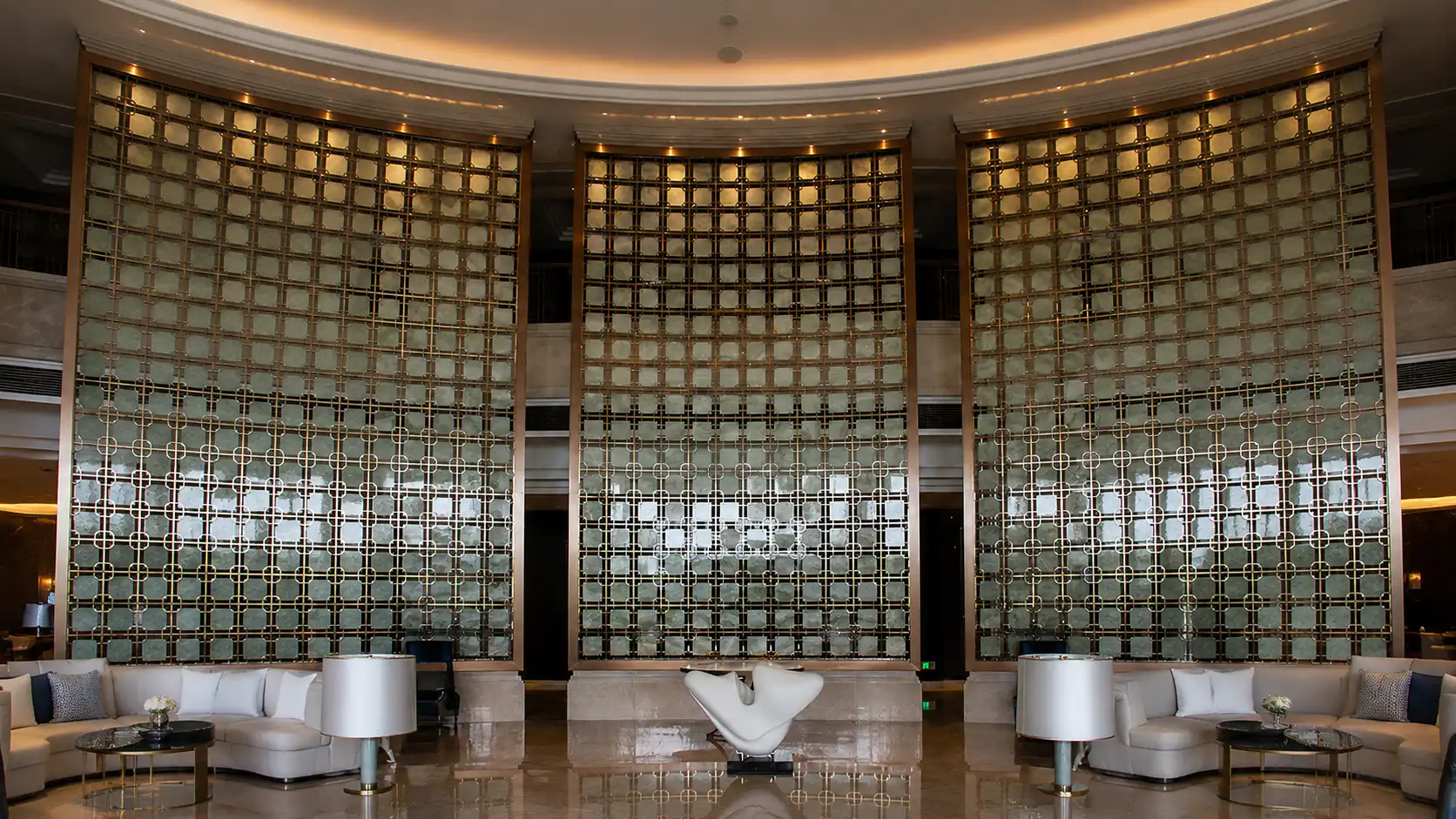
One of the strongest advantages of architectural perforated metal is the ability to convert patterns into project-specific design elements.
Traditional punching is efficient for regular repeated perforations, including round, square, and slot patterns. Laser cutting provides greater flexibility for irregular geometries, larger decorative openings, custom motifs, and complex pattern transitions.
Custom perforation can be developed for:
- Geometric architectural patterns
- Gradient opening densities
- Abstract decorative compositions
- Cultural or regional motifs
- Project-specific graphic concepts
- Repeated patterns across multiple panel modules
For large installations, pattern continuity should be considered from the beginning. Panel joints, edge margins, fixing positions, and module sizes can interrupt a design if they are not coordinated with the perforation layout.
Acoustic Enhancement
Perforated metal is frequently used as the visible surface of an acoustic ceiling or wall assembly. Sound waves pass through the panel openings and reach sound-absorbing materials installed behind the metal surface.
The effectiveness of the system depends on several factors:
- Open area ratio
- Hole size and spacing
- Panel thickness
- Acoustic backing material
- Air cavity depth
- Overall ceiling or wall construction
Perforated sheet in itself does not qualify as a total acoustic treatment solution. The main function of such a system is to have an architecturally sound face and at the same time allow sound to pass through to the acoustic treatment material.
This type of acoustic treatment system works well in office spaces, conference rooms, hospitality environments, auditoriums, and transport areas, among others.
Versatile Applications Across Modern Architecture
Perforated metal can extend a consistent visual concept across different parts of a building. The same pattern language may appear on an exterior facade, then continue indoors through ceilings, partitions, screens, or feature walls.
Жалпы қолданыстарға мыналар жатады:
- Perforated metal facades
- Secondary building skins
- Decorative ceilings
- Interior partitions
- Privacy and ventilation screens
- Қабырға қаптамасы
- Stair and equipment enclosures
- Backlit architectural panels
Each application may require different panel thicknesses, open areas, fixing methods, and edge details. As a result, customization should address both visual continuity and technical performance.
Considerations for Choosing Architectural Perforated Metal Panels
Successful perforated metal design depends on coordination between aesthetics, fabrication, structural requirements, and installation.
Aesthetic Compatibility
Proportions of Perforation should be in accordance with distance and proportionality of architecture. Finer designs stand out better when viewed up close, while larger perforations may have a bigger impact on a large wall surface.
Mock-ups help test the degree of transparency, reflectivity, shadows, pattern proportions, and visual continuity.
Functionality
The intended function should determine the perforation specification. Privacy screens, ventilation panels, solar shading, acoustic ceilings, and decorative walls may require very different open areas and panel configurations.
A visually attractive pattern may not provide the required airflow, screening, or structural performance unless these requirements are defined early.
Материалды таңдау
Stainless steel offers durability, strength, corrosion resistance, and a wide range of architectural finishes. Aluminum provides lower weight and is commonly selected for facade, ceiling, and screening systems.
Material grade and finish should correspond with interior or exterior exposure, environmental conditions, maintenance expectations, and fabrication requirements.
Perforation Design
Hole size, pitch, spacing, shape, and open area directly affect appearance and performance. Very dense perforation can reduce panel stiffness, while narrow bridges between openings may increase the risk of deformation during fabrication.
The perforation layout should therefore be developed together with panel thickness and dimensions.
Panel Rigidity and Flatness
The removal of material alters the performance of the structure of the sheet metal. The large sheets with a higher open area might need to have greater thickness, folds, stiffeners, or more support points.
Flatness is particularly critical when the surface finish is reflective.
Edge Margins and Pattern Continuity
Adequate unperforated margins are normally required around panel edges for forming, fixing, welding, or connection details.
For multi-panel installations, perforations should also align across joints. Careful panelization prevents visible interruptions in geometric or gradient patterns.
Collaboration with Suppliers
Complex architectural perforation benefits from early manufacturing input. Drawings, panel sizes, hole patterns, open-area requirements, finishes, tolerances, joints, and fixing details should be reviewed before mass production.
Samples and full-size mock-ups can also verify pattern scale, finish consistency, flatness, and fabrication feasibility before final approval.
Жиі қойылатын сұрақтар
What is open area in perforated metal?
Open area is the percentage of a panel surface occupied by perforations. It affects transparency, airflow, daylight transmission, screening, and the visual density of the finished panel.
How do hole size and pitch affect perforated metal panels?
Hole size determines the scale of individual openings, while pitch defines the distance between them. Together, they influence open area, appearance, airflow, privacy, and panel stiffness.
What is the difference between punched and laser-cut metal panels?
Punching is generally suitable for repeated standard hole patterns and efficient production. Laser cutting provides greater flexibility for complex geometric patterns, irregular openings, gradients, and customized decorative designs.
Can perforated metal be used in acoustic ceilings?
Yes. Perforated metal can form the visible face of an acoustic ceiling when combined with appropriate sound-absorbing backing and cavity construction.
Partner with an Architectural Perforated Metal Manufacturer and Supplier
Иноксфурт Металл is a global manufacturer of stainless steel decorative materials and custom architectural metal products. Custom perforated metal panels can be produced to project requirements, including material, dimensions, hole patterns, open area, finishes, and fixing details. Design, engineering, and fabrication support is available for facades, ceilings, partitions, screens, and wall cladding. Иноксфурт Металл компаниясымен байланысыңыз with project drawings, specifications, quantities, and finish requirements for technical review and quotation.